Last-minute changes get missed.
A tournament changes a game time or venue, but the information doesn't reach everyone quickly enough. Players arrive late, go to the wrong location or miss the game.
SPORTS INTELLIGENCE
Sports Intelligence is building a platform that connects people, organizations, competition, performance, communication, and knowledge to turn everyday sports activity into actionable intelligence.
Beginning with working team operations, tournament monitoring, scouting, and integrated payments, we're building toward a platform that helps coaches develop athletes, organizations strengthen relationships, and everyone make better decisions.
Built from working software. Proven in real competition.
THE PROBLEM
Teams, schedules, tournaments, communication, evaluations, events, payments and athlete development live across disconnected systems, spreadsheets, messages and people's heads.
That fragmentation isn't just inefficient. It creates real problems on the court and across the organization.
A tournament changes a game time or venue, but the information doesn't reach everyone quickly enough. Players arrive late, go to the wrong location or miss the game.
A storm, accident or changing traffic conditions threatens arrival times, but the schedule doesn't understand what is happening on the road.
Signals that an athlete is becoming frustrated or disconnected exist across interactions and activity. Too often, the club discovers the problem when the player quits or moves elsewhere.
A coach believes a concept has been taught and understood. The athlete hasn't actually mastered it. Performance suffers and frustration grows on both sides.
Tryout evaluations capture valuable observations, but when they are isolated from ongoing development, coaches and athletes lose the ability to connect an evaluation to what happened afterward.
THE SOLUTION
Sports Intelligence connects team operations, schedules, communication, competition, events and payments in one platform. Organizations can adopt practical capabilities alongside existing systems, without replacing them all at once. That working foundation supports a longer-term vision of intelligence that connects activity across the organization and helps people act with context.
Know when schedules, venues, opponents or other important information changes without constantly checking for it.
Existing Event Operations capabilities surface readiness gaps and operational risks. Future intelligence aims to add context around athlete development and disengagement.
Future Combined Intelligence aims to turn connected context into useful guidance so coaches, families and organization leaders spend less time finding information and more time acting on it.
As more activity becomes connected, Sports Intelligence can recognize more relationships, preserve more context and provide more useful intelligence over time.
The sports technology landscape is built around point solutions. Team platforms manage rosters and schedules. Tournament systems publish events and brackets. Communication tools connect people. Payment systems move money. Video and statistics products capture what happens in games. Each sees one part of the sports operation.
Sports Intelligence is built around the connections between them. Because teams, athletes, coaches, events, competition, communication and finances operate through the same platform, everyday activity creates connected signals that isolated applications cannot create on their own. Those signals become the foundation for intelligence across the operation.
THE PRODUCT
Sports Intelligence is working software, not a platform concept. Teams and organizations can already run everyday operations, communication and events while the activity they create becomes connected context for the intelligence layer.
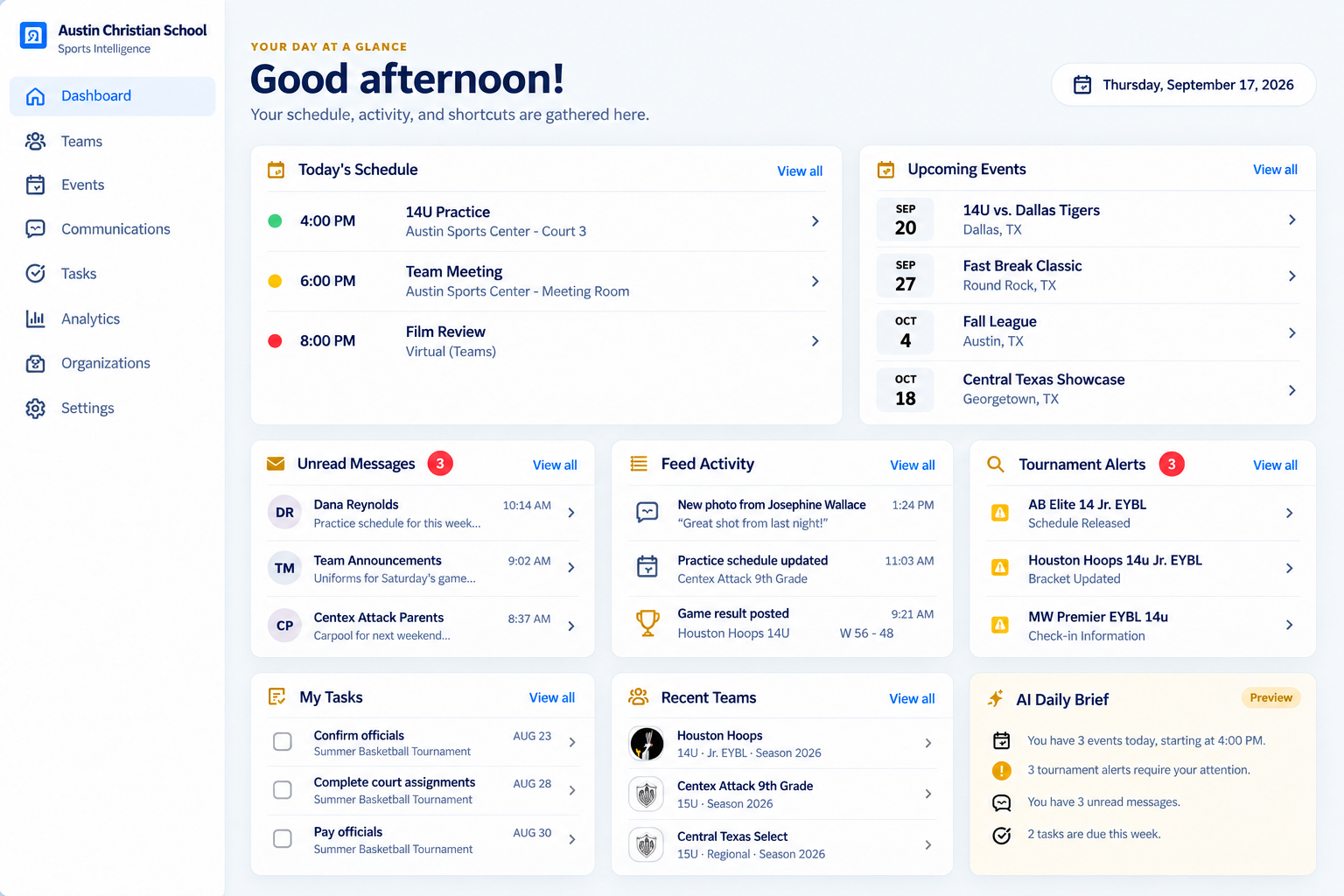
Schedules, messages, activity, tasks and tournament alerts come together in one operational view.
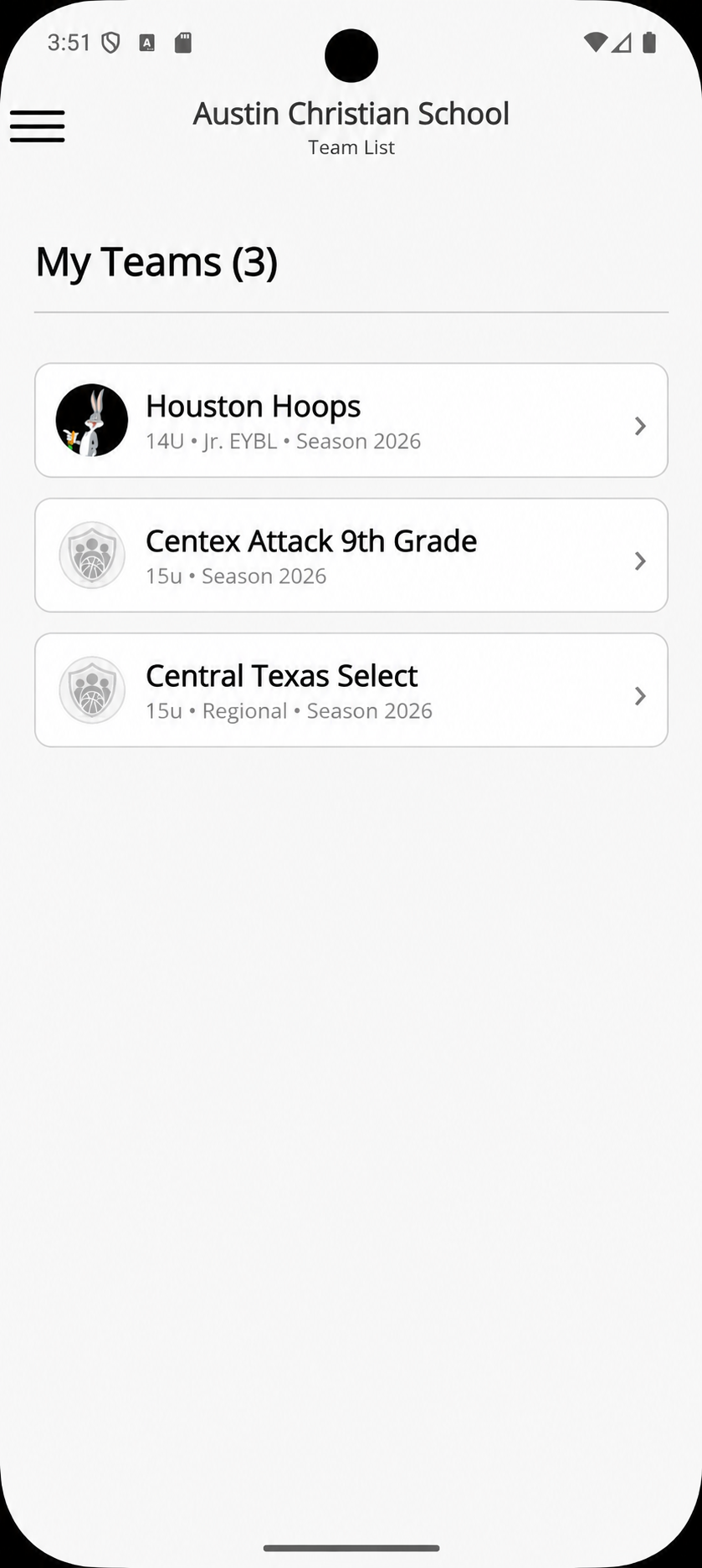
Teams, rosters, schedules and the relationships between athletes, parents and coaches.
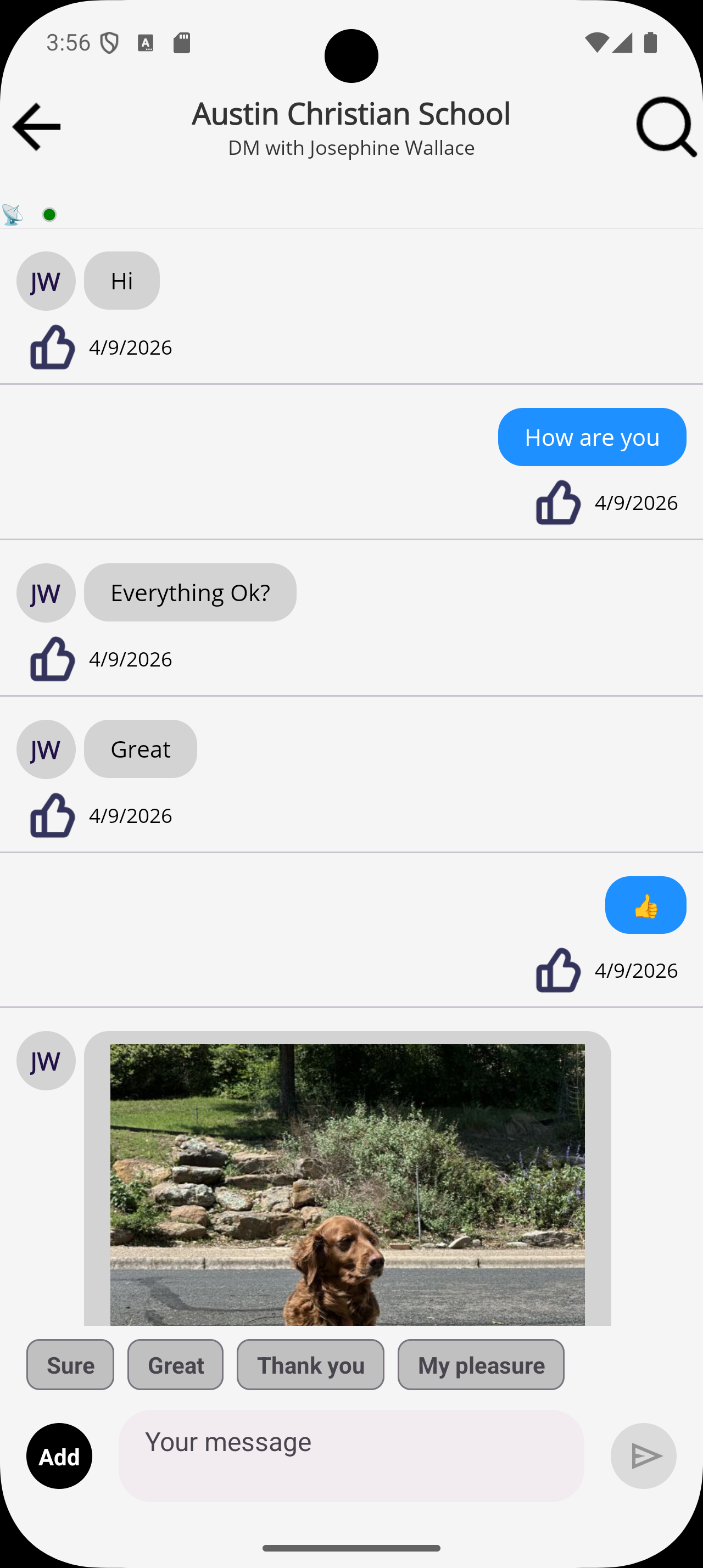
Posts, messages, polls and conversations stay connected to the teams, people and activity they are about.
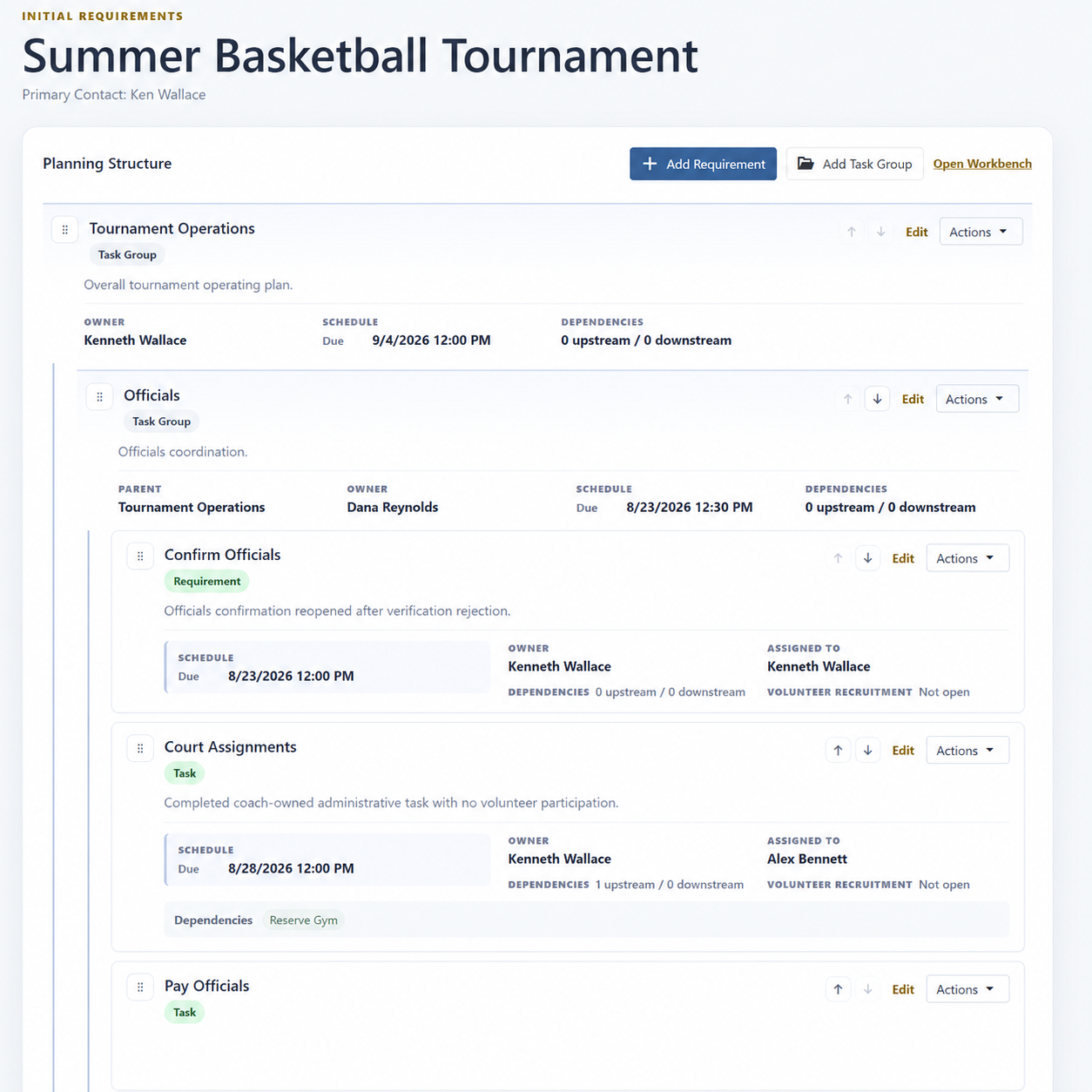
Requirements, tasks, ownership, assignments and operational readiness managed in one connected workspace.
Manage teams, rosters, schedules, practices, games, tournaments, attendance and the relationships between athletes, parents and coaches.
Keep posts, conversations, polls, comments, media, notifications and schedule changes connected to the teams and activity they belong to.
Plan and execute complex events through structured requirements, tasks, ownership, assignments, dependencies, staffing, readiness and verification.
Collect and manage registrations, team fees and other payments directly within Sports Intelligence, with integrated support for platform fees.
Tournament Watcher monitors tournament changes, while Scouting Reports turn opponent history and results into actionable competition context.
Use requirements, dependencies, assignments, staffing, schedules and execution status to understand readiness, identify risk and surface what needs attention.
Every schedule change, conversation, event, game, tournament and transaction adds context to the same connected sports model.
INTELLIGENCE IN PRACTICE
Tournament Intelligence is the first expression of the larger Sports Intelligence model. It solves immediate problems in competitive basketball today while beginning to build the competition history and connected context that can power intelligence across the platform.
MONITOR
Continuously monitor tournament schedules, opponents, venues and bracket changes, surfacing what changed without requiring coaches and families to repeatedly check tournament systems themselves.
UNDERSTAND
Turn accumulated opponent history, results and available performance data into structured, opponent-specific scouting intelligence for a level of basketball where traditional scouting infrastructure is largely unavailable.
ACT
Bring schedule changes, opponent intelligence and relevant game context together so coaches can quickly understand what changed, what matters and what comes next.
Tournament Intelligence is the first premium capability available across the Sports Intelligence platform, with seasonal access for families, coaches, teams and clubs.
Tournament Watcher access, with Tournament Watcher + Scouting Reports packages available from $39.
Individual coach access or intelligence access across an entire team.
Includes up to five teams, with additional teams available as the organization expands.
Pricing varies by season length. Spring/Summer packages are priced higher to reflect the longer competitive season.
Tournament Watcher continuously observes public tournament systems for schedules, teams, opponents, venues and changes as events unfold. Every observation adds to a growing competition history that does more than power alerts. It becomes context for scouting, teams, coaches, events and organizations throughout Sports Intelligence.
REAL WORLD PROOF
Sports Intelligence isn't only a technology concept. Its intelligence has already helped coaches prepare and make decisions at the highest level of competitive youth basketball.
HOUSTON HOOPS • 14U JR EYBL
Coach Temaine Wright used Sports Intelligence Scouting Reports during the team's run at the 2026 Nike Nationals EYBL tournament and credited the reports with making the difference in multiple wins.
After seeing the reports in use, other Houston Hoops coaches asked for access.
ORGANIZATION-LED GTM
Organizations adopt Sports Intelligence across their teams, creating immediate distribution to coaches, athletes and families. Core access is free when the organization processes the required transaction volume through the integrated payment platform.
MARKET OPPORTUNITY
Sports Intelligence does not need to capture the entire youth sports economy to build a meaningful business. Competitive basketball alone represents tens of thousands of teams, thousands of tournament events and significant payment activity already flowing between families, organizations and tournament operators.
Estimated player registration volume based on 50,000–100,000 competitive teams, 10 athletes per team and an average $1,600 registration fee.
Modeled tournament registration volume across the 302,672 team entries already observed by Tournament Watcher in 2026.
Modeled gate activity using 10 athletes per team, 1.5 paid spectators per athlete and a single $25 admission per spectator.
THE CORE PLATFORM MODEL
Organizations that process qualifying transactions through Sports Intelligence/FOP can receive the core organizational software without a separate software subscription. A representative club can generate transaction revenue before purchasing a single premium capability, removing a software-subscription barrier while establishing an economically productive relationship from the start.
Potential annual registration platform revenue if all 50 clubs process the modeled registration volume through FOP.
Illustrative example assumes 10 athletes per team. Across the seasonal registrations shown above, the weighted average registration fee is $1,600 per athlete. Sports Intelligence revenue assumes a 1% platform fee passed through to the payer as part of the transaction. The 50-club scenario is illustrative only—not existing revenue, contracted ARR, or a claim that every club generates $9,600 annually.
Competitive youth basketball is the initial market. Planned expansion includes other youth sports, high school athletics, collegiate athletics and advanced sports intelligence markets. Professional sports represents a longer-term opportunity. The $40B+ figure describes the U.S. youth sports economy only, not the combined size of these expansion markets.
Tournament activity is based on first-party Tournament Watcher data through September 21, 2026, limited to observed events lasting seven days or fewer. National competitive-team count is an estimated range. Player registration volume assumes 10 athletes per team and a $1,600 average registration fee, consistent with the representative club economics shown above. Tournament registration is modeled using conservative fee assumptions by event duration. Gate activity assumes 1.5 paid spectators per athlete and only one $25 admission per spectator, regardless of tournament duration. Broader youth sports market context: PwC, Sports Industry Outlook 2026.
WHY NOW
Youth sports has become increasingly digital, but the activity is still fragmented across operational systems. Schedules, communication, payments, tournaments, video, statistics and athlete activity now create a growing stream of digital signals. What has been missing is the ability to connect that activity economically and turn it into useful intelligence.
More of the activity surrounding teams, athletes, events, payments and competition now happens through software, creating signals that previously disappeared into paper, spreadsheets and disconnected communication.
Modern infrastructure makes it practical to retain operational history, connect relationships across the sports ecosystem and continuously process activity at a scale that would previously have required far greater capital.
Connected activity no longer has to remain passive data. AI can help interpret large amounts of operational context, identify relationships and turn accumulated signals into intelligence people can act on.
AI-assisted development allows an experienced technical founder to implement, test and iterate much faster while architecture, domain modeling and product decisions remain founder-led. That changes the economics of building a broad vertical platform.
BUSINESS MODEL
Sports Intelligence aligns its economics with the activity already happening inside a sports organization, while creating additional paid value as the platform expands. Transaction revenue supports the core platform; planned subscriptions provide an alternative for organizations that do not process qualifying transactions through FOP.
Platform fees are earned from registrations, tournament entries, gate admissions and other qualifying payments processed through Sports Intelligence/FOP.
Qualifying FOP activity can provide the core organizational software without a separate subscription.When the full Organization Operations Platform (OOP) becomes available, organizations that do not process qualifying transactions through FOP can subscribe directly for the organizational software.
Planned full OOP pricing: $5,000–$10,000 annually per organization. This is an alternative, not an automatic added fee.PRODUCT ROADMAP
Sports Intelligence is not a collection of independent products. Each new capability extends the same connected operating model, building on infrastructure, relationships and data already in place.
Teams, communication, events, competition and payments are already creating connected operational data across the platform.
Rosters, schedules, practices, games, tournaments, attendance and relationships.
Posts, conversations, polls, comments, media and notifications.
Schedules, planning, requirements, tasks, ownership, staffing, readiness, risk and execution.
Tournament monitoring and notifications when games or schedules change.
Opponent game histories, results and common opponents for game preparation.
Payment processing for registrations, team fees and other transactions.
Current and upcoming development, progressing from OOP Phase 0 toward the full Organization Operations Platform.
OOP Phase 0 is the initial organizational foundation. The full OOP remains future development, extending teams and events into broader organizational operations and intelligence.
These are progressive development areas. Full organizational intelligence is a future capability, intended to help operators anticipate constraints and focus attention where it matters.
Future capabilities would bring game analysis, coaching knowledge and athlete development history into the connected platform.
Connected coaching observations, knowledge, documents and media.
Structured game and performance analysis, supported by game events and statistics.
Athlete development history and future performance and mindset intelligence.
Future Communication Intelligence, Relationship Intelligence, Mindset Intelligence and Organizational Intelligence would amplify one another as more context becomes available. Connecting these domains could support cross-domain recommendations and Gravity intelligence related to attraction and retention.
Learning from actions and outcomes is part of this future vision. Advanced AI and Combined Intelligence are not operational capabilities today.
The shared operating model, relationships, identity and accumulated history provide the foundation for every stage. The architectural vision connects facts to signals and intelligence, then actions and outcomes that can inform future learning.
COMPOUNDING INTELLIGENCE
Sports activity does not happen in isolation. Performance, mindset, communication, events, finances and relationships affect one another. As Sports Intelligence connects more of that activity, intelligence from one part of the platform can add context to another. The examples below illustrate the future Combined Intelligence vision, building on working operational and competition capabilities.
Changes in mindset can provide context for changes in athlete performance and development.
Communication context and relationship history can add meaning to participation, performance, engagement and retention.
Operational risk, staffing, attendance and execution can help explain event costs, revenue and financial outcomes.
Future Combined Intelligence could help explain attraction, retention and movement across athletes, coaches, teams and organizations.
COMMUNICATION + RELATIONSHIP INTELLIGENCE
Different athletes respond differently to coaching, feedback, encouragement, correction and communication. An approach that motivates one athlete may discourage another.
Sports Intelligence aims to connect appropriate communication context, coaching observations, participation, performance and relationship history to help coaches and organizations communicate more effectively.
The goal is to help people make better-informed decisions, not label athletes or replace the judgment of coaches, families and organizations.
Any future guidance would require youth-appropriate privacy, meaningful consent, carefully defined access controls and responsible use of personal information.
Each new intelligence does more than add another capability. It adds context to what Sports Intelligence already understands, creating new relationships across performance, people, operations and outcomes. The value comes from the connections between them.
Sports Intelligence is being designed with youth privacy as a foundational platform concern, including age-aware identity, guardian relationships, consent, appropriate access controls and responsible data retention. Individual athlete information and aggregate organizational intelligence are treated as distinct uses of data.
Sports Intelligence connects working team operations, events, schedules, communication, payments and competition. Everyday use creates the foundation for future Combined Intelligence. Organizations can adopt these capabilities alongside existing systems, with full OOP and game activity planned to extend that foundation over time.
As those signals accumulate across athletes, coaches, teams, organizations and competition, the platform develops connected history and context that a new entrant cannot recreate by simply copying features. The longer an organization operates through Sports Intelligence, the more the platform knows and the more valuable that intelligence becomes.
COMPANY + FOUNDER
JKW Sports Intelligence is completing its formation as a Delaware C-Corporation to build and commercialize Sports Intelligence, a connected operating and intelligence platform for sports.
Founder • Software Architect • Entrepreneur
View LinkedIn Profile →Ken is a technology architect and entrepreneur who has built and sold businesses in multiple industries. Technology was a driving force behind both Sierra Radiation Dosimetry and JKW Home Services, where software, automation and connected operating systems were used to create more efficient and scalable businesses. He designed and built the technology foundation behind Sports Intelligence and continues to lead the product, architecture and intelligence strategy.
Sports Intelligence grew from years of firsthand exposure to competitive youth sports and the operational problems surrounding teams, tournaments, communication and organizations. Those relationships provided access to real workflows and real competition, allowing the platform to be developed alongside the people using it rather than from assumptions about how the sports industry operates.
Built and sold two businesses in different industries, with technology serving as a driving force behind the operations, efficiency and competitive advantage of both.
Architected and built the connected domain model, operating platform and intelligence foundation behind Sports Intelligence.
Years inside competitive youth sports through multiple children, relationships with coaches and club directors, and direct exposure to clubs competing at the highest levels have provided firsthand visibility into how teams and organizations actually operate and where existing systems fall short.
Sports Intelligence enters commercialization with working software, a shared technical foundation and real-world product validation already in place. Capital can be directed toward adoption and expansion rather than funding the platform from scratch.
Team operations, communication, event operations, competition intelligence and integrated payments are already running on the same connected platform. The next phase is expanding adoption and turning real-world validation into repeatable distribution.
New capabilities extend a shared domain model, identity system, relationships and operational data rather than requiring independent products and technology stacks.
AI-assisted development accelerates implementation, testing and iteration while product architecture, domain modeling and technical direction remain founder-led.
SPORTS INTELLIGENCE
Sports Intelligence is moving from working software and real-world validation into broader commercialization. To learn more about the company, its technology, and its growth strategy, contact us to request additional information.
Request Company Information